
Music for a Sports Bar: Does a Jukebox Fit While the Game Is On?
A sports bar without a game is just a dark room with TVs. Here is how a QR jukebox fills the gaps between fixtures without fighting the broadcast.
- Who it is for
- Sports bar owners who want the room to have a pulse on game days, between games and on nights without a fixture.
- Search intent
- commercial
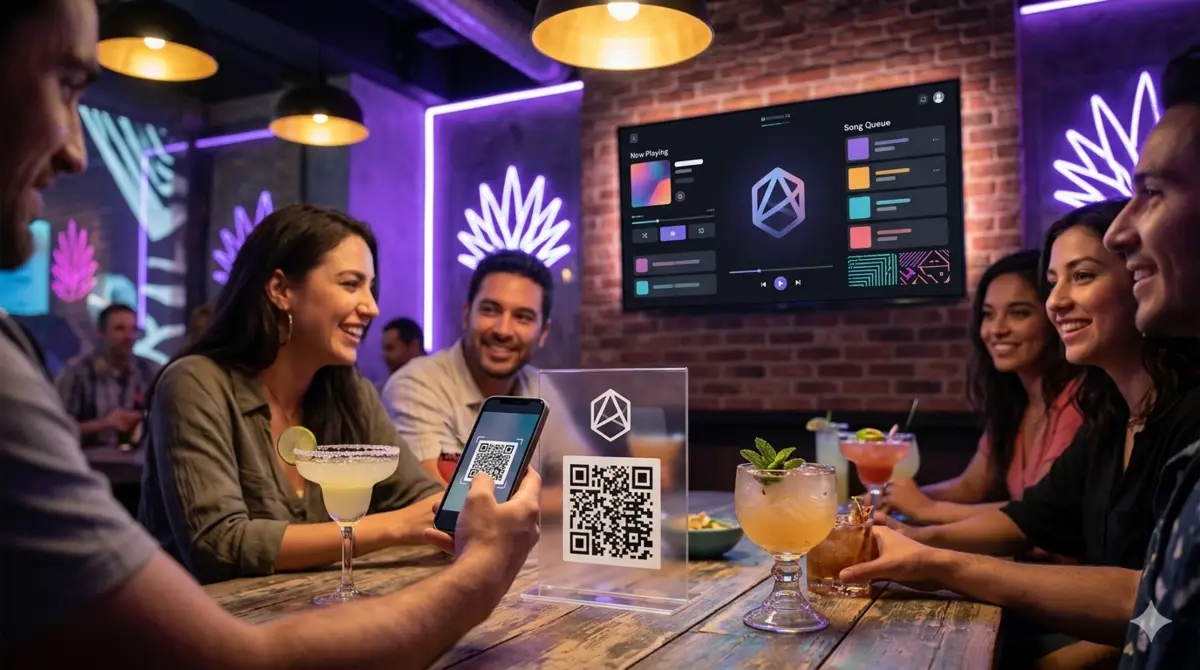
A sports bar has a split personality that shows up in the numbers. On game night the TVs are the show and the room fills by itself. The rest of the week — the morning after, a Tuesday, a Saturday with no fixture anyone cares about — that same room is a crowd of TVs showing nothing. The music decision is really a decision about the second half of that split.
This article is about how a QR jukebox (a music screen guests control with their phones by QR) fits a sports bar without fighting the broadcast, and how it changes the economics of the days nobody marks in the calendar.
Where the jukebox lives when the game is on
The rule that keeps a sports pub from turning into a mess is separation of screens. The main flatscreen TVs belong to the broadcast; the wall screen (or a projector, or the TV away from the bar) belongs to the jukebox. They never fight for the same pixels.
That separation is what makes the jukebox usable at all in a sports bar. During the game:
- The queue fills between plays and at halftime: guests add songs that will play in the breaks, so the wall screen becomes a countdown of what's coming once the whistle goes.
- Volume is the venue's call. The jukebox music runs under or over the broadcast depending on the moment; in Rockola.app the owner decides the sound mix and can even schedule the jukebox's on/off so it never blasts through a penalty shootout.
- The broadcast never loses the main TVs, because the request channel is music, not video on the match screens. That's precisely the constraint a "play whatever on the big TV" playlist would break.
The real problem is the nights without a fixture
Count the dead hours in a sports bar's week: the bar has maybe four or five meaningful fixtures, and a pub that lives off them is empty the other twenty-seven days. The jukebox turns the wall screen into the reason to stay after the final whistle.
Two mechanics that sports bars actually use:
- Happy hours with music. Between 5 and 8 PM on a night without a game, the jukebox screen runs and the staff lowers the lights one notch: the room reads as "open, warm, doing something" instead of "TVs off, lights on, why are you here".
- Credit stickers as the promo. Print QR codes that load credits (that's the "códigos" feature: the venue generates the codes, costs nothing until redeemed) and hand them out with the second drink, or raffle them through the night. The promo's whole cost is the ridiculously low price of a redeemed code.
Game day economics don't need help; the week between games is where the margin of a sports bar is fought. That week is precisely what the jukebox addresses, because its whole day-zero pitch is "music that rotates by itself without staff curating a playlist."
How sports bars differ from regular bars
The situation is distinct enough that the setup should differ from a normal bar's:
| Decision | Regular bar | Sports bar |
|---|---|---|
| Jukebox screen position | Center, on the wall | A screen away from the main TVs, usually near the bar |
| When it matters most | Friday and Saturday night | Between fixtures and after the last whistle |
| Volume policy | Steady, on top | Scripted around the broadcast |
| Marketing angle | "Come choose the song" | "Happy hour with music on dead nights" |
That table is the internal punchline: a generic music screen in a sports bar fails only if it is installed without deciding who it serves when the marquee event is not on. Decide it during setup and the two halves of the room stop being in tension.
What owners ask us about this
Will guests complain the songs "aren't on brand"?
What they usually mean is volume or genre during a key moment, which is a rules problem, not a catalog problem. Set the blacklist for the genres you never want on the floor (or for that one artist that grown-ups find grating) and trust the rotating queue for the rest — the crowd is self-selecting at any hour.
Do sports bars break even on a QR jukebox?
The subscription is cheap (Starter is $5 USD/month and Professional is $10 USD/month with 30-day free trial), so breaking even is not the question; the question is whether the dead night pays its rent. The bar already pays for the sound system and the screens. The jukebox monetizes nights that otherwise cost money standing still.
Doesn't the broadcast own the sound system on game day?
It owns the moment. Between plays and at halftime the broadcast sound drops, and that exact notch is where the jukebox belongs — or the room goes quieter than a waiting room. Owners who set schedule + volume once at setup tell us it stops being a discussion after the second week.
Conclusion
A sports bar is two businesses and the jukebox reconciles them. On game nights it sits to the side of the broadcast and fills the gaps. On the three quiet nights a week, it is the reason the room has a pulse. If the pitch makes sense, the setup is on you: create the venue, put the QR on the tables, choose which screen is music-only and open the player. Try it for 30 days before you believe any of this.
Frequently asked questions
Does a jukebox work in a sports bar where the TVs show the game?
Yes, if the music screen is separate from the broadcast TVs. The match owns the main screens; the jukebox owns a wall screen near the bar, and the two never fight for the same pixels. Volume and schedule get set once at setup.
What does a sports bar need to run a QR jukebox?
A screen with internet in a browser, its audio connected to the venue's sound system (a cheap HDMI audio extractor if the TV lacks a line-out), and a printed QR per table zone. No hardware and no technician.
Can I throttle the jukebox during a match?
Yes. The venue can schedule the jukebox off during a key match, set a volume policy per moment, and blacklist songs by title — so the tension between "music on" and "match on" is decided in the settings, not improvised at 9 PM.
How does a jukebox help sports bars on nights without a game?
It turns the quiet night into a "happy hour with music": the wall screen plays the queue guests request, and QR credit codes handed out as promos pull people in. The nights without a fixture are where the weekly margin of a sports bar is fought.
How much does adding a jukebox to a sports bar cost?
No hardware. The subscription is between $5 and $25 USD a month on the Starter/Professional/Premium plans, plus the printed QR codes.
Try it in your venue
Turn the screen you already own into a digital jukebox
Set up your venue in about a minute and get your own jukebox URL, your table QR and your dashboard. 30-day free trial, no charge until it ends.